
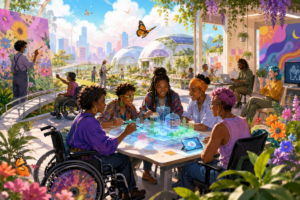
Speculative Design, Prefigurative Futures, and the Radical Imagination of Black and Disabled Communities
Every society tells stories about the future. Governments imagine future economies. Corporations imagine future products. Military planners imagine future conflicts. Designers imagine future technologies.
But there is another tradition of future-making that rarely receives the same recognition. Across generations, Black communities and disabled communities have been imagining and building futures that dominant society declared impossible. We have not simply dreamed about better worlds—we have rehearsed them.
This is where speculative design and prefigurative politics meet.
What is Speculative Design?
Speculative design asks a deceptively simple question:
What if?
Instead of designing products to solve today’s market problems, speculative designers create artifacts, experiences, performances, technologies, and stories that invite people to inhabit possible futures. These works are less concerned with predicting tomorrow than expanding what people believe is possible.
Speculative design is not forecasting.
It is imagination as social practice.
A speculative design project might imagine a city without prisons, an internet owned by communities instead of corporations, or technologies built around care rather than extraction. Sometimes these futures appear in films, games, theater, architecture, virtual worlds, or everyday objects that seem to come from another timeline.
The purpose is not to say, “This is what will happen.”
The purpose is to ask, “What if we chose differently?”
What are Prefigurative Futures?
Prefigurative politics begins from another question:
How do we live the future now?
Rather than waiting for institutions to change, prefigurative communities organize themselves according to the values they hope society will eventually adopt.
If we want accessibility, we practice accessibility now.
If we want mutual aid, we practice mutual aid now.
If we want abolition, we practice forms of accountability that reduce reliance on punishment.
If we want liberation, we begin living liberation.
The future becomes a rehearsal rather than a destination.
Prefigurative work recognizes that every meeting, every gathering, every artwork, every online space, and every relationship is an opportunity to prototype another world.
Black Communities Have Always Practiced Future Design
Black history is filled with speculative thinking.
Harriet Tubman imagined freedom before it existed for millions of enslaved people.
Maroon communities designed societies outside colonial rule.
The Black Arts Movement imagined cultural institutions independent of white validation.
Afrofuturism asks not only what Black futures look like, but what worlds become possible when Black people are centered rather than marginalized.
Sun Ra declared we came from another planet.
Octavia Butler showed that adaptation, community, and change are survival technologies.
Black speculative traditions understand that imagination is not escapism.
It is infrastructure.
When the existing world refuses your humanity, imagining another one becomes a survival skill.
Disabled Communities Have Always Been Future Builders
Disabled people are often portrayed as recipients of accommodation rather than designers of culture.
The opposite is true.
Disabled communities continually invent new ways of organizing time, communication, technology, architecture, performance, and relationships.
Crip Time refuses industrial schedules.
Disability Justice imagines communities where interdependence replaces independence as the measure of success.
Access Riders redesign artistic collaboration.
Remote participation challenges assumptions about presence.
Captioning, audio description, tactile graphics, alternative communication systems, and flexible participation all began as access practices. Many later became mainstream innovations.
Disabled people regularly ask questions like:
What if rest was productive?
What if participation had many forms?
What if bodies were not standardized?
What if access was beautiful instead of hidden?
These are speculative design questions.
Access is Worldbuilding
Accessibility is often misunderstood as compliance.
In reality, accessibility is worldbuilding.
Every access feature imagines a different audience.
Every accommodation proposes a different social contract.
Every accessible event says:
“You belong here.”
Access is not an add-on after the future has been designed.
Access is the design process itself.
When we begin with disabled people, we frequently create experiences that benefit everyone.
Theater as a Laboratory for Future Society
Performance has always been a place where societies rehearse possibilities.
Theater allows us to temporarily suspend existing rules and experiment with different relationships.
But immersive and participatory performance offers something even more powerful.
Instead of watching another world, audiences enter it.
They make choices.
They care for one another.
They negotiate access.
They participate in collective meaning-making.
In this sense, immersive theater becomes speculative design.
The audience is no longer consuming a future.
They are practicing one.
This is especially true when performances integrate disability justice, mutual aid, consent, accessibility, and collective authorship into the structure of the experience rather than presenting them merely as themes.
Digital Spaces as Sites of Liberation
Virtual worlds are often dismissed as less real than physical ones.
For disabled communities, they have long been sites of experimentation.
Digital gatherings make room for people whose bodies, immune systems, transportation, caregiving responsibilities, or economic realities limit participation in traditional cultural spaces.
Virtual festivals.
Livestream performances.
Online communities.
Digital encampments.
Accessible gaming spaces.
These are not substitutes for “real” community.
They are communities.
The internet can reproduce oppression, but it can also become a laboratory where new forms of governance, access, creativity, and participation are prototyped before they appear elsewhere.
Building the Future Through Art
Artists are often asked to reflect society.
Perhaps a more important question is whether artists can rehearse society before it exists.
Every installation that invites collective care…
Every accessible performance…
Every community archive…
Every speculative game…
Every augmented reality poem…
Every mutual aid gathering…
Every consent-centered design process…
These become acts of future-making.
Art does not merely document change.
Art creates conditions where change becomes imaginable.
The Work Ahead
Black and disabled communities understand that survival has always required imagination.
We cannot wait for institutions to become accessible before practicing accessibility.
We cannot wait for justice before practicing justice.
We cannot wait for liberation before rehearsing liberation.
Speculative design gives us permission to imagine.
Prefigurative practice gives us permission to begin.
Together they remind us that the future is not something waiting for us somewhere ahead.
The future is something we practice every time we gather, every time we create, every time we make access visible, every time we refuse systems that diminish our humanity, and every time we invite others into worlds that are more just than the ones we inherited.
The question is no longer whether another future is possible.
The question is whether we are willing to start living it today.