
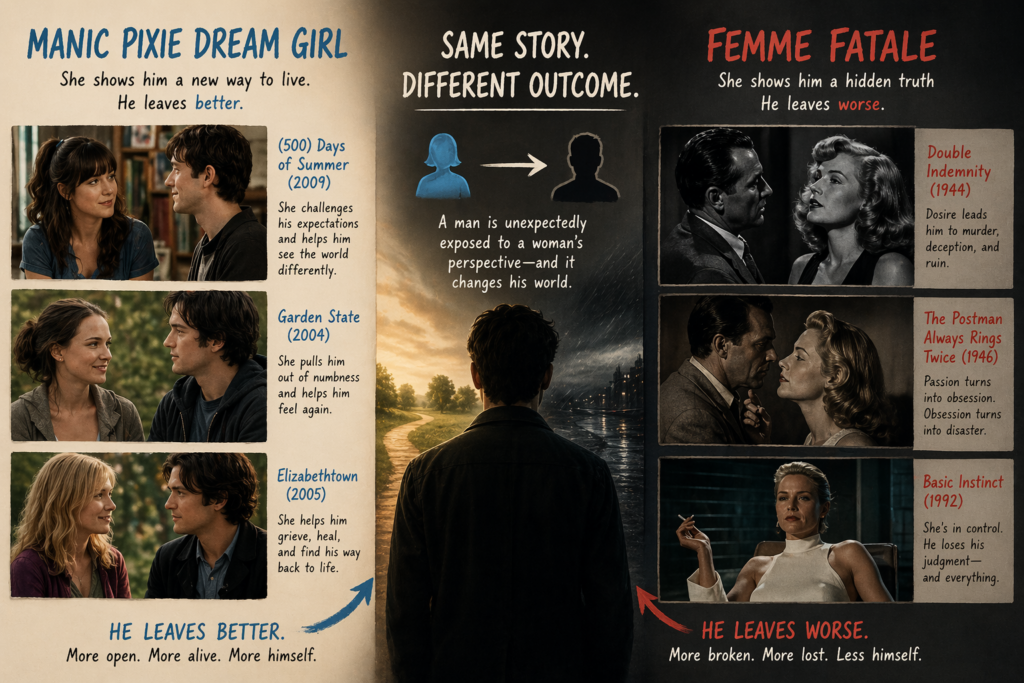
What is the difference between the manic pixie dream girl and the femme fatale? One is a much older trope, but that is not the real answer. Both feature a male protagonist who is unexpectedly exposed to a woman’s perspective, presence, or way of being, and it changes his world. Manic pixie dream girls leave the dude better. Femme fatales leave the dude worse. Both are patriarchy-serving tropes that uphold supremacy culture in storytelling.
The femme fatale comes from older narrative traditions that fear women with autonomy. She is seductive, strategic, mysterious, and difficult to control. When a man encounters her, he is pulled off course. He compromises himself. He becomes obsessed. He loses money, safety, status, morality, or life itself. The story frames her as the spark, but often what she really reveals are weaknesses already present in him. His greed, vanity, entitlement, and hunger do the rest.
The manic pixie dream girl performs a more flattering version of the same structural job. She is quirky, emotionally free, spontaneous, creative, and often detached from practical burdens. She appears when a man is stagnant, depressed, cynical, or spiritually asleep. Through contact with her, he becomes more open, more alive, more vulnerable, more himself. She teaches him wonder, risk, or emotional honesty. Her own interior life is often thin because the story is invested in his awakening, not her reality.
This is why the true distinction is outcome. The femme fatale is written so the man declines after contact with feminine power. The manic pixie dream girl is written so the man improves after contact with feminine power. One warns him. One saves him. Both center him.
These tropes also serve supremacy culture in storytelling through who gets to make them, finance them, and profit from them. For generations, many of these stories were written by men, greenlit by men, directed by men, and built as star vehicles for men. The male protagonist gets the depth, the screen time, the prestige arc, and the paycheck. The woman is cast as the mechanism that moves his story forward. Even when she seems powerful, the structure still serves him.
They also function as propaganda for patriarchy. The manic pixie dream girl tells audiences that women should revive men, inspire men, heal men, and ask for little in return. The femme fatale tells audiences that women with too much agency, appetite, sexuality, or independence are dangerous and must be feared, punished, or contained. One says women should serve men and be loved for it. The other says women who do not serve men are trouble.
Repeated over decades, these stories normalize male centering as common sense. Men are presented as the natural subject of life, while women orbit as helpers, rewards, distractions, temptations, or threats. Audiences are trained to track his growth and see her value through what she provides to him. Meanwhile the industry around these narratives often concentrates money, prestige, and power in male hands.
That is why these are not just character types. They are industrial myths that reinforce who matters, who gets complexity, who gets served, and who gets paid. One fixes him. One ruins him. Both keep him at the center.