
🎲 Calling Up Justice does D&D
A joyful, access-centered adventure—and the first of many
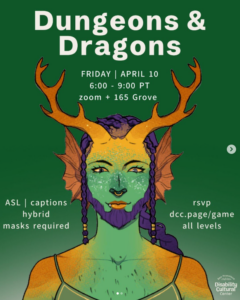
On April 10, 2026, the San Francisco Disability Culture Center hosted its first-ever Dungeons & Dragons night—an access-forward, hybrid gathering that brought together players, audience members, and facilitators across physical and digital space. 3 in-person rooms played and one digital space was provided.
This event was led by co-director Emily Beitiks, with organizing support from Azaleah Goose, who has been developing a disability-forward one-shot campaign format. The featured adventure, Horror of the Shade, was originally written by Theo Kogod and adapted for the DCC by Azaleah, with further accessibility edits from Dr. Vivian Delchamps Wolf to support crip time, readability, and ease of play.
Calling Up Justice was proud to participate in multiple roles: Claudia Alick served as both Dungeon Master and advisor to the center; Ry joined as a player; and additional members of the practice supported preparation and attended as audience.
🧙🏾♀️ The Invitation
The event was designed with access at its core:
“The dice are polished, the snacks are nonstop, the chairs are cozy, and our dungeon masters are ready – it’s our first D&D night! … We’ll craft community agreements for each campaign based on access needs and care notes… Joining us virtually? You’ll watch real-deal players run a campaign while you keep it fantastic in the chat.”
Access features included ASL, captions, hybrid participation, and masks required in-person—demonstrating a commitment to care and multiplicity in how people could engage.

⚔️ Preparing for Play
A few days before the event, Calling Up Justice hosted a short test session with Claudia, Maddie, Maiamama, Ry, and Jesenia. Like any good rehearsal process, this allowed the team to experiment, troubleshoot, and build familiarity.
Claudia’s prep included:
- Deep review of characters and story pathways
- Creation of visual assets to support theater of the mind
- Building a DM screen and digital setup
These preparation practices helped translate a traditionally in-person game into an engaging hybrid experience.

🐉 The Adventure Unfolds
The event featured multiple tables running simultaneously in person, while Claudia led a digital table with experienced players including Ry, Shaina Ghuraya, and Jen Kretchmer.
And what unfolded?
Everything.
There was combat.
There was magic.
There was romance.
There was a very cute sphinx.
While the campaign included battle mechanics, this particular table leaned into conversation, collaboration, and even moments of restorative justice. Players made clever, emotionally grounded choices that shaped a rich and surprising story.

🎭 Audience as Co-Creators
One of the most exciting elements of the night was audience participation.
Audience members:
- Stepped in as NPCs in caravan scenes
- Threw rocks at goblins (with great enthusiasm)
- Cheered players on
- Engaged in lively side chats to collaboratively solve the sphinx’s riddle—without spoiling it
This layered participation created a feeling of collective storytelling, where the line between audience and player became fluid.
♿ Disability as Story Engine
Several characters were explicitly disabled, with additional mechanics incorporated to reflect those experiences in gameplay.
This wasn’t just representation—it was integration.
The presence of disability within the mechanics and narrative made the story more dynamic, more grounded, and more reflective of the lived experiences of players and audience alike. It opened up new kinds of problem-solving, creativity, and connection.
😂 Joy, Learning, and What’s Next
We laughed a lot. And we learned a lot.
Accessibility is an ongoing practice—not a fixed achievement.
Some reflections from the experience:
- For producers: Accessibility can be complex and labor-intensive, especially the first time. This event required flexibility and individualized approaches for each DM.
- For facilitators: Working in partnership (including tech support) is key to sustaining access and reducing strain.
- For participants: Multiple modes of engagement—small tables, hybrid access, and digital participation—allowed more people to find their way in.
Claudia participated remotely to support her access needs, demonstrating how hybrid design can expand who gets to lead and contribute.

🎥 Learn More: Accessible Playing
For those interested in continuing to build accessible TTRPG spaces, we recommend following Jen Kretchmer, a professional DM who shares her work on Twitch at @dreamwispjen. (These are mostly projects she’s worked on, but many of my recommendations for things she *hasn’t* worked on are linked in the Accessibility in Gaming Resource Guide):
- She runs a few directories for disabled folks in TTRPGs
- Sign Language Interpreters in TTRPGs Directory (I’d love to get the amazing terms from tonight to add themselves, if they’d be interested — I use this for official D&D events, various Actual Plays, and other TTRPG projects, as well as a reference resource for folks looking to have events interpreted. I also know there are a few projects starting in the next few months that will need regular interpreters, so I’d love to have a few more folks available!): https://docs.google.com/forms/d/e/1FAIpQLSeIxsBf5HWKqyiZaYwkLyRw4rTshDN0PCqUYuzYbNcybZAYug/viewform
- Disabled Pros in TTRPGs: A roster of disabled creators, artists, writers, designers, etc. working in the TTRPG industry: https://forms.gle/SVmCXivW33VTCg1e9
- Disabled Vendors in TTRPGs: A roster for disabled makers and crafters who sell TTRPG-related merchandise: http://bit.ly/3yjrRBs
- PLEASE NOTE: All of these directories require creators to use no AI. (Most TTRPG publishers have “No AI” clauses which can result in creators getting fired for using any generative AI in the development, writing, or artistic process.
- The Accessibility in Gaming Resource Guide: A resource list about accessible gaming, holding accessible events, etc. (I’m hoping to update this again later this year): https://docs.google.com/document/d/1ZFSXz-Yva1KZAsP7NblCdkoiQ6RcjxSV2gj98eXusJs/edit?usp=sharing
- The D&D for All Kit I designed (Unfortunately, the thread with photos went away when I left Twitter, but this article includes photos): https://threadreaderapp.com/thread/1605439110297985024.html . While these kits aren’t available anywhere, a lot of what we included in them CAN be reproduced in inexpensive ways to create similar tools for folks who want to make their home games more accessible.
- And Art Description, the new form of TTRPG image description I developed for MCDM’s Draw Steel, which a few other games are starting to use: https://files.mcdmproductions.com/DrawSteel/DrawSteelArtDescriptionGuide.pdf. It was created to improve equity in description of the incredible art we are getting in gaming books, and is based on museum description standards.
- Galesong, an all-disabled Actual Play put together by D&D: https://www.youtube.com/watch?v=H0E8bLmHQ78&list=PLH2mZMZVrUMxLQzuAxh-w3PNSKMdpr8mi&themeRefresh=1
- The TTRPG Safety Toolkit: https://ttrpgsafetytoolkit.com/
- The MCDM Tabletop Safety Toolkit: https://www.patreon.com/posts/announcing-mcdm-73512191.
- The Fate Accessibility Toolkit: https://evilhat.com/product/fate-accessibility-toolkit/
🌱 Looking Ahead
This first D&D night was a powerful proof of concept.
Accessible, disability-forward TTRPGs are not only possible—they are vibrant, connective, and deeply engaging. With continued iteration, modular design, and shared learning, this can grow into an ongoing program that invites even more people into storytelling, play, and community.
Calling Up Justice is excited to continue supporting this work—as DMs, players, collaborators, and co-designers of future accessible campaigns.
This is just the beginning.