
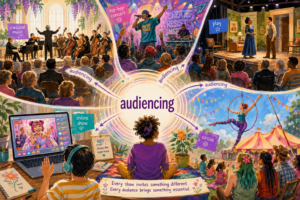
We often talk about creating art, performing art, producing art, and funding art. Far less often do we talk about the equally important act that makes all of those things matter: audiencing.
Audiencing is not passive. It is an action.
Just as we speak of parenting, teaching, gardening, or organizing as verbs that describe ongoing practices, audiencing describes the active practice of witnessing, receiving, interpreting, responding to, and completing a work of art. A performance does not fully exist until someone audiences it. The audience is not outside the artwork—they are one of its essential collaborators.
This shifts a fundamental assumption. Instead of imagining artists as the only makers of meaning, audiencing recognizes that meaning is co-created. Every laugh, silence, gasp, tear, dance move, chat comment, standing ovation, awkward pause, whispered conversation afterward, or changed perspective becomes part of the performance itself. The artwork lives in the relationship between performer and audience.
Different forms of art ask for different kinds of audiencing.
A symphony invites stillness, concentration, and careful listening. The audience’s quiet attention creates the acoustic space that allows delicate sounds to exist.
A hip-hop concert asks for movement, call-and-response, celebration, collective energy, and participation. The crowd becomes another instrument.
A circus asks us to suspend disbelief, anticipate risk, and physically react with awe and delight.
A theater production may ask us to empathize with fictional characters, wrestle with difficult ideas, or imagine ourselves inside another person’s experience.
An online livestream invites entirely different behaviors: typing in chat, sharing emojis, clipping favorite moments, joining from across the world, multitasking, or returning repeatedly to archived recordings. Digital audiencing expands presence beyond physical proximity.
Each art form trains us in different social behaviors. There is no single “correct” audience. There are only audiences whose practices match the invitation being offered.
Recognizing audiencing as a practice also helps explain why accessibility matters so deeply. If audiences complete the artwork, then barriers to participation are not merely inconveniences—they diminish the work itself. A performance without disabled people, elders, children, multilingual communities, or economically marginalized people is not simply missing audience members. It is missing perspectives that shape the meaning of the event.
Accessible audiencing therefore becomes an artistic practice, not merely a compliance exercise. Captioning, ASL interpretation, audio description, relaxed performance practices, masking, sensory supports, transportation assistance, childcare, and affordable tickets do more than welcome people. They expand the range of possible interpretations, emotional responses, and relationships that can emerge. Accessibility increases the intelligence of the audience.
Audiencing is also a skill that can be cultivated.
We can learn to listen more deeply. We can practice curiosity instead of judgment. We can notice our own emotional responses. We can support artists financially. We can recommend work to friends. We can ask thoughtful questions. We can witness difficult stories without demanding comfort. We can allow ourselves to be surprised, challenged, delighted, or transformed.
In this sense, audiencing is a civic practice.
Healthy communities depend on people who know how to witness one another. Art provides one of the safest places to rehearse that skill. Every performance teaches us how to pay attention together. Every gallery asks us to slow down. Every concert reminds us that emotion can be shared. Every gathering creates temporary communities built through collective attention.
Perhaps the most radical aspect of audiencing is that it asks us to contribute without taking center stage. In a culture that increasingly rewards broadcasting ourselves, audiencing reminds us that receiving is also creative. Attention is a form of generosity. Presence is a contribution. Witnessing is labor.
Artists often receive credit for making culture, but audiences make culture too. They decide what survives, what spreads, what becomes tradition, what inspires conversation, and what changes lives. Every audience member carries the work beyond the theater, gallery, screen, or street performance into their own relationships and communities.
Art does not end with applause.
It continues wherever audiencing has changed someone enough that they begin to see differently, speak differently, gather differently, or imagine new possibilities.
To audience is to participate in culture. To audience is to practice community. To audience is to help create the world the artwork is trying to imagine.
The next time we buy a ticket, log into a livestream, visit an exhibition, or stop to watch a street performer, we are not merely consuming art.
We are audiencing.
And through audiencing, we become co-creators of the experience itself.