
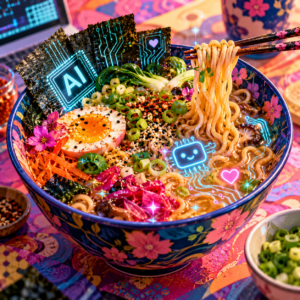
Artificial Intelligence Is My Instant Ramen
By claudia alick
Inspired by conversation in criptech incubator meeting october 2026
When I was a young adult, I didn’t eat instant ramen regularly. It was instant food. It considered it gross and unhealthy. I ate whole foods that required more labor: shopping for ingredients, chopping vegetables, standing at a stove, cooking a meal. I took pride in this and also was a little righteous about my choices. .
Then I suddenly became physically disabled.
Standing and walking became difficult. Using my left arm became almost impossible. The things I had considered simple parts of cooking were no longer simple. I was trying very hard to remain independent, and I discovered ramen bowls.
Peel open paper top. Add hot water. Wait. Eat.
They worked for feeding myself, but I didn’t particularly like the taste. There was an artificial flavor. They didn’t have a chew factor like vegetables or meat.. So I started souping them up.
I added precut scallions because chopping them myself was difficult. I added precooked meat.. I ordered dumplings and put them on the ramen with a sweet chili sauce. During the beginning of the pandemic in 2020, people all over TikTok were sharing ramen hacks. Keep the flavor packet but add a spoonful of chunky peanut butter. Add prechopped garlic and ginger, brown sugar and soy sauce and make a special sauce.
We were all transforming a standardized package into something more.
My bowl of ramen is unique. It contains my preferences and my creativity. I made decisions about what belonged in it. I adapted it for my body and my tastes.
But did I cook it?
Is it food?
Those questions remind me of the questions people ask about my art that used artificial intelligence in the production process.
As I lost more ability to use my hands and to stand for long periods, I couldn’t always stand at a canvas and paint. So I started making art from bed with my thumb, a cell phone and a collection of apps.
I might talk into my Notes app then feed those words into a language generator, asking it to format them. I might draw a stick figure or make a collage and feed that into an image generator. I might use my own poetry as the prompt for an image.i might combine different generated items and combine them into an animation.
Lately, I’ve been taking some of my early AI images and printing them out. I mount them on cardboard. I add dried flowers, paint and glitter. They become new physical art objects.
They remind me of my ramen.
I am using AI for some of the same reasons I eat instant ramen. It reduces the labor between what my body can do today and something I need or desire to make.
That doesn’t mean I believe the systems producing either product are harmless.
The industrial production of cheap convenience food can have consequences for workers, communities, bodies and the environment. Some companies sell cheap, unhealthy food into poor communities while people have few affordable alternatives. I don’t respond to that reality by blaming a poor person for eating ramen.
I think about AI similarly.
The massive systems producing generative AI can consume enormous resources, exploit human labor and intellectual property, and create harms for communities. Corporations can use AI to make decisions that hurt people. There are AI systems whose practices I find so exploitative or harmful that I choose not to use them.
There are also kinds of ramen I won’t eat.
But I gotta feed myself.
And I gotta express myself.
Disability has changed the amount and kinds of labor available to me. I can care about the systems behind the things I consume while also acknowledging the reality of the body I live in. Sometimes the accessible thing is also compromised. Sometimes the affordable thing is not the ideal thing. Sometimes survival means working with what is available and changing it as much as I can.
The ramen doesn’t come out of the package as my meal. I have a relationship with it. I modify it. I season it. I add things. I reject things. I make choices within choices that have already been made for me.
My relationship with AI is similar.
I don’t experience myself as pushing a button and asking a machine to be creative for me. I’m cooking with ingredients I didn’t manufacture, using tools I didn’t build, inside systems I don’t completely control. That has always been part of making things. What disability has changed is which tools I need in order to keep making.
Maybe the question isn’t whether I cooked the ramen.
Maybe the question is: Did I nourish myself?
And maybe the question about AI art isn’t whether the machine made the art.
Maybe it’s: Did I create something that carries my voice, my body, my aesthetics and my experience?
I can critique the factory and still eat.
I can critique artificial intelligence and still use it.
As a disabled person, I cannot afford to build my ethics around feeling guilty about how I survive.
I gotta eat.
And I gotta make art.