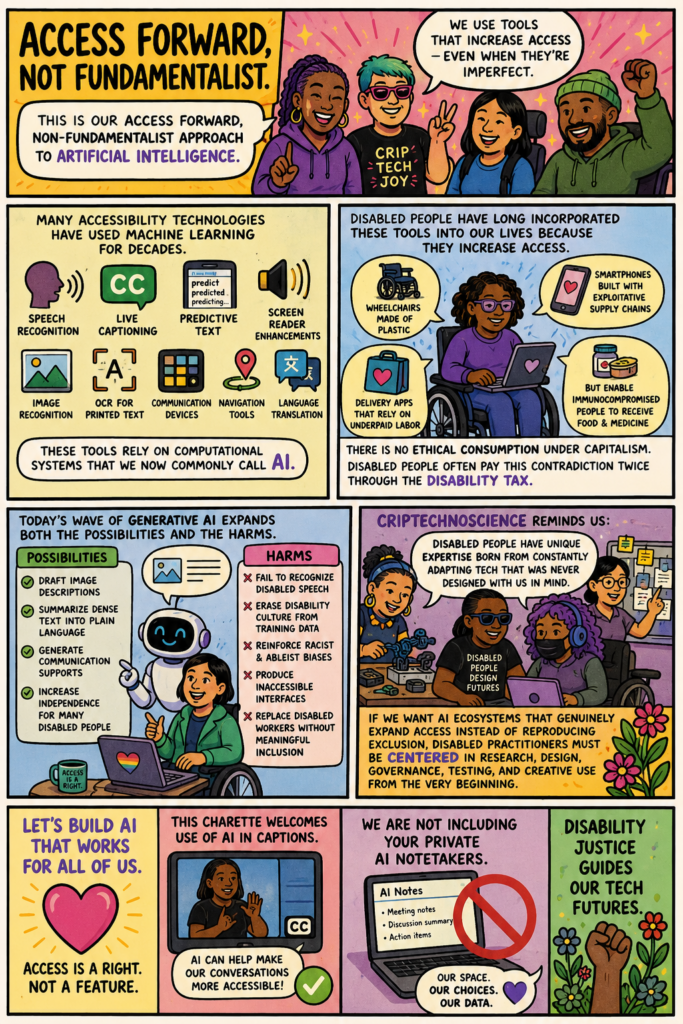
This is an access forward non-fundamentalist framing for our engagement with artificial intelligence. We are resisting access-washing. Many accessibility technologies have used machine learning for decades. Speech recognition, live captioning, predictive text, screen reader enhancements, image recognition, OCR for printed text, communication devices, navigation tools, and language translation all rely on computational systems that are now commonly described as AI. Disabled people have long incorporated these tools into our daily lives because they increase access, even when they are imperfect. Like wheelchairs made from plastic, smartphones built with exploitative global supply chains, or delivery apps that rely on underpaid labor while enabling immunocompromised people to receive food and medicine, these technologies exist within unethical systems. There is no ethical consumption under capitalism, and disabled people often pay this contradiction twice through the disability tax—having to purchase, learn, and depend upon technologies simply to participate in society.
Today’s wave of generative AI expands both the possibilities and the harms. AI can draft image descriptions, summarize dense text into plain language, generate communication supports, and increase independence for many disabled people. At the same time, it can fail to recognize disabled speech, erase disability culture from its training data, reinforce racist and ableist biases, produce inaccessible interfaces, and replace disabled workers without meaningful inclusion in its design.
The debate around AI and disability echoes earlier conversations about plastic straw bans. The environmental harms of disposable plastics are real, just as the environmental, labor, surveillance, and cultural harms associated with AI are real. But recognizing a harm does not mean every response to that harm is just. Blanket plastic straw bans often treated disabled people who needed flexible, sanitary, inexpensive straws as acceptable collateral damage, while leaving much larger sources of plastic pollution untouched. The lesson is not that we should ignore environmental harm; it is that justice requires solutions that do not remove essential access from people with the fewest alternatives. We can bring that same disability justice lens to AI.
Criptechnoscience reminds us that disability is not simply a group that AI should accommodate after the fact. Disabled artists, engineers, researchers, designers, and everyday users have unique expertise born from constantly adapting technologies that were never designed with us in mind. If we want AI ecosystems that genuinely expand access instead of reproducing exclusion, disabled practitioners must be centered in the research, design, governance, testing, and creative use of these systems from the very beginning.