
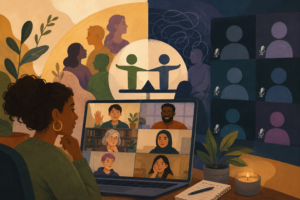
At Calling Up Justice, we do not require participants to be on camera in digital meetings. We believe that engagement should not be measured through surveillance. Someone’s value to a conversation is not determined by whether their face is visible on a screen. We recognize that people participate from many circumstances: chronic illness, caregiving responsibilities, sensory needs, fatigue, unstable internet, privacy concerns, or simply having a difficult day. Accessibility means making room for all of those realities.
At the same time, years of facilitating digital spaces have taught us that the conversation is more complicated than “camera on” versus “camera off.”
When everyone is off camera, facilitating a meeting can feel a little like teaching from inside a dark room where you cannot see anyone. Facial expressions, body language, and visual cues provide important information that helps us understand one another. A facilitator can see confusion, excitement, discomfort, curiosity, or agreement without anyone saying a word. Those signals help us adapt, clarify, and create shared meaning.
Without those cues, communication becomes harder. It can feel discouraging to ask questions and receive only silence. A facilitator may begin to wonder: Is anyone listening? Did that idea land? Did that story connect? If a tree falls in a forest and no one is there to hear it, does it make a sound? Similarly, did the teacher have an impact if there is no evidence that anyone in the classroom received what was offered?
Of course, there are many valid reasons to be off camera. As a disabled person, there are times when I need my camera off because I am managing something that would be difficult or distracting to navigate under observation. Being seen can sometimes interfere with my ability to participate. In those moments, turning off the camera serves access.
But there are other times when people stay off camera because they feel they are not presentable enough. They worry about their appearance, their home environment, or whether they look professional. In our spaces, we welcome participation from beds, couches, pajamas, and blankets. We are not looking for performance. We are looking for presence.
When fear, shame, or insecurity become the primary reasons for staying unseen, the camera-off choice may no longer be serving accessibility. Instead, it may create distance between participants and make it harder to build trust, comfort, and connection with one another.
This challenge becomes even more significant because many of us no longer have regular in-person opportunities to build relationships. Digital spaces are often the primary place where our communities gather. Text chat alone is rarely sufficient for creating strong group dynamics, deep collaboration, or genuine community. We need opportunities to see each other, recognize each other’s humanity, and practice being together.
There is another factor worth considering: cameras off can make multitasking easier. People answer emails, scroll social media, cook meals, or work on other projects while a meeting continues in the background. While everyone occasionally needs flexibility, habitual multitasking can reduce engagement and undermine the collective experience. Community is built when people bring their attention, not just their attendance.
The question, then, is not whether cameras should always be on. They should not. Nor is the answer that cameras should never matter. Instead, we must recognize that accessibility is not only about the needs of individuals. It is also about the needs of the group.
The challenge is finding balance between honoring personal agency and creating conditions where collective trust, communication, and relationship-building can flourish. Sometimes access means turning your camera off. Sometimes access means feeling safe enough to turn it on.
What matters most is that we remain thoughtful about the impact our choices have on ourselves and on one another. Accessibility is not merely the removal of barriers. It is the ongoing practice of creating spaces where people can fully participate, connect, and belong.