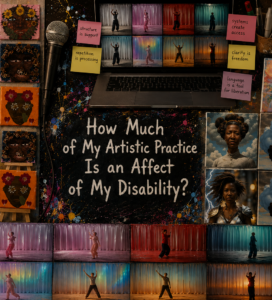
How Much of My Artistic Practice Is an Affect of My Disability?
How much of my artistic practice is an affect of my disability? The answer is not simple, because disability does not sit outside my work as a theme or identity category. It shapes the way I make, repeat, organize, move, communicate, process, and finish things. My artistic practice is not only influenced by disability. It is built through the specific ways my disabled bodymind understands and survives the world.
I am a slam poet and a published poet, and poetry has always been one of the clearest places where this shows up. I experience echolalia. I repeat language because of meaning, but also because of sound, rhythm, pressure, and mouthfeel. Sometimes a word feels good coming out of my mouth. Sometimes a phrase loops in my head until it becomes a poem. Repetition is not just style for me. It is a processing tool. It is how thought gathers force.
My poetry comes from the way I metabolize the world. A line can begin as a sound, a repeated phrase, a question, a joke, a wound, or something I overheard and cannot put down. Slam poetry gave me a form where repetition, intensity, rhythm, and embodiment were not only allowed but celebrated. The stage gave my language a place to land.
But writing is bigger than poetry for me. Journaling, essay writing, reports, reflections, proposals, and public language are also major outcomes of my practice. Sometimes I do not know what I think until I write. Writing is not always me recording a finished idea. Writing is how the idea becomes visible to me. I write to understand what I believe. I write to make sense of conflict. I write to build structure around emotion and information. I write because otherwise the thoughts stay tangled inside me.
Lately, painting has become another place where disability shows up clearly. I have been working on a painting series, and I keep thinking I am done. The series could have been done at twenty paintings. That would have been a complete body of work. But now I am framing the thirty-fourth one and wondering: will they all even fit in the gallery?
That question is funny, but it is also real. The paintings are getting finished. This is not about being unable to complete work. It is about the series continuing to generate itself because my brain has not released the task yet. The process is soothing, yes, but it is also obsessive. I keep making because the making keeps answering something. The repetition of faces, flowers, materials, color, texture, and framing becomes its own system. I am not only painting images. I am following a pattern until my brain allows me to stop.
My producing practice is also connected to disability. I need specific meeting practices, communication practices, space practices, and event practices in order to function. I need clarity. I need rhythm. I need containers. I need systems I can understand and trust. Producing gives me a way to design those systems instead of being harmed by systems that were not made for me.
This is part of why I produce the way I do. When I create accessible structures for meetings, events, rehearsals, digital spaces, and collaborations, I am not only making things accessible for other people. I am making them accessible for myself. I am controlling the conditions of the room enough that creativity can happen. Producing is not separate from my art. It is one of my art forms. It is systems design as survival practice.
And then there is dance. My dance practice is also inseparable from disability. I dance all the time. I dance to regulate. I dance to move energy through my body. I dance because stillness is not always neutral for me. Dance is a stim.
Being a dancer gave me a socially legible container for movement that might otherwise be labeled strange, excessive, distracting, or weird. People do not label you as moving weird all the time if they understand you as a dancer. They call it choreography. They call it expression. They call it practice. But underneath that social permission is the truth that my body has always needed to move.
So how much of my artistic practice is an affect of my disability? Almost all of it. Not because disability is the only thing I make work about, but because disability shapes the mechanics of how I make work at all. It shapes my repetition, my language, my systems, my pacing, my obsession, my movement, my need for structure, and my need for release.
My disability is not separate from my artistic practice. It is one of the engines of it.