There was a time when open mics and poetry slams were where I went to build work, not just present it. They were laboratories—messy, alive, responsive. You tried a line, felt the room shift, rewrote it in your body in real time. Since the pandemic, those spaces have been inconsistent, inaccessible, or simply unsafe for many of us—especially disabled folks. Something vital got interrupted.
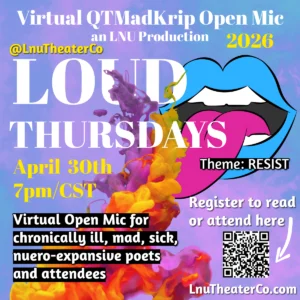
That’s why Loud Thursdays, hosted by Loud ‘N Unchained Theater Co. (LNU), feels so important.
Loud Thursdays is not just a virtual open mic—it’s a designed space. A disability justice-centered container where chronically ill, mad, sick, and neuro-expansive artists are not an afterthought but the core. That shift changes everything. The pacing, the access, the tone, the expectations—it all opens up possibility.
What strikes me most is how the chat becomes part of the performance. Audience members reflect lines back, echo phrases, offer observations in real time. It’s call-and-response, but reimagined through digital space. Then, after each set, a facilitator reads the chat aloud. That moment—hearing your words refracted through the audience, curated and spoken back—is electric. It’s dramaturgy. It’s witnessing. It’s feedback that lives somewhere between poetry and community care.
This Thursday, I shared work from my newest poetry collection, Art Power Growth Liberation. Loud Thursdays held it exactly the way I needed. Not passively. Not politely. But actively, responsively, with texture. The room met the work and pushed it forward. I could feel where the language landed, where it stretched, where it needed more breath. That kind of space doesn’t just showcase art—it develops it.
And that doesn’t happen by accident.
Producing digital community space like this takes people. It takes planning. It takes deep intention and thoughtful design. It takes an understanding that access is not a checklist but a creative practice. LNU is doing that work. As a Black, queer/trans/disabled (QTMadKrip) collective of artists, abolitionists, and healers, they are building something that feels both rigorous and caring—structured and alive.
Loud Thursdays reminds me that the future of performance isn’t just about returning to what we had. It’s about building spaces that actually hold us. Spaces where disabled artists can experiment, fail, grow, and transform in real time. Spaces where the audience is not separate from the work but part of its evolution.
I don’t just leave Loud Thursdays feeling seen.
I leave with better poems.