
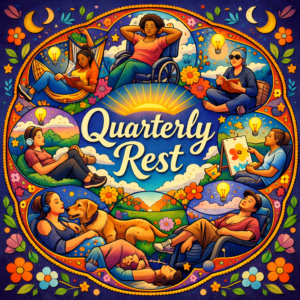
Calling Up Justice is a disability justice–informed practice. Like many groups doing movement work, we are fueled by urgency: injustice does not pause, crises keep coming, and the communities we love often need immediate support. Even when we try to pace ourselves, the rhythm of projects, events, and collaborations can carry us right to the edge of our capacity. We realized that although we talked about sustainability, we rarely had enough time to actually recover before the next wave of work began.
So we tried something different. Four times a year, the entire practice takes a full week off. A collective rest week. No programming, no internal meetings, no pressure to produce. The purpose is simple: regain capacity.
What we learned during our first week of rest surprised us.
The first lesson was that resting takes practice. Many of us spent the first few days feeling physically sick, exhausted, or emotionally drained. When the momentum of constant work suddenly stopped, our bodies seemed to release everything they had been holding. Even more revealing was how quickly we reached for labor out of habit. We kept wanting to fill the time with productivity—emails, planning, small tasks—because working is what we are trained to do when we do not know what else to do.
That habit is a survival strategy, especially for people working inside under-resourced movements. But it is still a habit. During those early days we caught ourselves judging our own exhaustion. We wondered why we could not immediately leap into hobbies or joyful activities. Why were we so tired? Why couldn’t we “make better use” of the time?
Eventually we realized: that was the point.
Rest week revealed how deeply we have been indoctrinated by a society that equates worth with productivity. We are taught that our value comes from constant output, constant usefulness. The act of simply resting—of existing without producing—can feel uncomfortable, even wrong.
But disability justice offers another framework. Principles like wholeness and anti-capitalism remind us that our worth is inherent. We do not need to earn the right to exist through endless work. Our bodies, minds, and spirits deserve care simply because they are ours.
Once we moved through that initial exhaustion, something shifted. With more energy returning, the rest week began to open space. Some people used the time for practical life tasks—gardening, cleaning, finally getting a passport renewed. These were things that had been waiting on the margins of busy schedules.
But the deeper shift was the return of spacious thinking. Without the constant pressure of deadlines, our minds had room to wander. We could dream again. We found ourselves thinking about long-term visions for our work, imagining new possibilities, reconnecting with the reasons we started this practice in the first place.
We also had time for self-directed creativity. People cooked good meals, experimented with art projects, read books, and spent time with friends. These activities were not assigned or strategic—they were simply nourishing.
And that nourishment matters. A practice like Calling Up Justice depends on imagination, relationship, and care. When those wells run dry, the work suffers. Rest is not the opposite of the work; it is what makes the work possible.
By the end of the week, the difference was clear. People felt stronger. Clearer. More grounded. Instead of limping into the next season of programming, we were entering it with renewed capacity.
Because of that, we now see these quarterly rest weeks as one of the most important investments we can make in our future programming. Sustainability is not just about funding or infrastructure—it is about the health of the people doing the work.
One of the most important lessons we learned is that rest must be collective. In our practice we use crip resilience strategies like shared leadership and distributed responsibility, but even with those structures it is difficult for anyone to truly rest when a project is still actively moving forward. If programming continues, someone has to answer emails, coordinate logistics, or solve problems as they arise. The person checking the inbox cannot actually take a break if the flow of communication never slows down. What we realized is that rest only works when the entire system pauses together. By taking the week off as a whole practice—no meetings, no events, no expectations—we reduced the need for communication and decision-making across the board. That collective pause allowed everyone, including the people who usually hold administrative or coordination roles, to actually experience rest. The shared commitment to slowing down made it possible for each of us to step away without worrying that the work would quietly continue without us.
When we shared this initiative with other organizations, the response was overwhelmingly positive. Many people recognized the same problem: the constant push of movement labor without enough space for recovery. Our hope is that practices like this can spread. Collective rest should not be a luxury; it should be part of how we design sustainable movements.
For Calling Up Justice, the experiment worked. We learned that rest takes practice, that exhaustion needs time to surface, and that dignity does not come from constant productivity.
Most importantly, we learned that when we truly pause, our capacity to imagine, create, and care for each other grows stronger.
And we are already looking forward to the next quarterly rest week.