
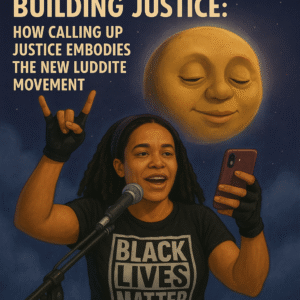
Breaking Machines, Building Justice: How Calling Up Justice Embodies the New Luddite Movement
Claudia Alick reads Brian Merchant’s “Why You Should Be a Luddite” to livestream audience during EarlyWords Liberation Meditation, connecting 19th-century textile workers to today’s fight for technological justice
In the soft morning light streaming through her window, Claudia Alick settles into her familiar ritual from the comfort of her bed. The founder of Calling Up Justice opens her laptop, adjusts her microphone, and transforms into a talking moon floating in a universe of stars. On screen, her lunar avatar glows serenely against the cosmic backdrop as a rocket sporadically flies past, adding whimsy to the surreal digital space where she shares her daily EarlyWords Liberation Meditation with the community gathered in her livestream. But today’s reading carries special weight—Brian Merchant’s “Why You Should Be a Luddite,” an article that seems to speak directly to the work she and her collective have been doing.
“The history of the Luddites,” Alick reads aloud, her voice carrying across digital waves to listeners scattered around the globe, “gives us a framework to evaluate the utility of technologies and their social impacts.” She pauses, letting the words settle. Her audience—activists, artists, disabled creators, and community organizers—lean in through their screens, recognizing something familiar in this 200-year-old story.
As Alick continues reading about the textile workers of 1811 who smashed the “obnoxious machines” that threatened their livelihoods, she pauses to share her own witnessing of this pattern. During her time working for The Cutting Corporation and The American Foundation for the Blind producing audiobooks, she watched skilled neuroatypical workers—masters of the old reel-to-reel machines—get systematically fired when companies switched to ProTools. These were craftspeople who understood their analog equipment intimately, who could splice tape with surgical precision and mix audio with decades of embodied knowledge.
“Now, twenty years later,” she tells her lunar avatar audience, a rocket drifting past in the digital cosmos, “narrators and audio engineers are facing the same threat—being replaced with AI.” The cycle continues: skilled workers displaced not because their work lacks value, but because new technology offers capitalists cheaper alternatives that concentrate profits while destroying livelihoods.
The parallels to Calling Up Justice’s work become unmistakable. Like those early industrial workers—and like the audiobook craftspeople she once worked alongside—Calling Up Justice isn’t anti-technology. They’re anti-exploitation through technology.
From Textile Looms to Algorithmic Feeds
“They were against the machinery ‘hurtful to commonality,'” Alick emphasizes as she reads Merchant’s explanation of Luddite philosophy. The phrase resonates powerfully with her livestream audience, many of whom have experienced firsthand how social media algorithms suppress marginalized voices, how AI systems perpetuate bias, and how digital platforms extract value from communities while giving little back.
This is precisely why Calling Up Justice created Followers Forever—their app that allows users to maintain direct connections with creators, bypassing the algorithmic gatekeepers that control what content gets seen. It’s a thoroughly modern form of Luddism: not breaking the machines, but breaking the exploitative systems that govern how those machines operate.
During the WGA and SAG-AFTRA strikes, when Hollywood writers and actors drew red lines around AI use in their industries, Calling Up Justice showed up—literally marching in Los Angeles and creating “Speculative Stories for the Strike,” an anthology project that amplified worker voices in the fight against algorithmic replacement.
The Non-Innocent Entanglement
As Alick reads Merchant’s analysis, she weaves in connections to the crip technoscience manifesto that guides much of Calling Up Justice’s work. The manifesto’s concept of “non-innocent entanglement” acknowledges technology’s embedded relationships to systems of oppression—the military-industrial complex, colonialism, surveillance capitalism—while insisting on the necessity of engaging with these tools strategically.
“Calling Up Justice recognizes that innocence is a mythological state produced by supremacy culture,” Alick explains to her audience, expanding on the reading. “We’re forced to deny the ways tech is built on stolen data with stolen labor to produce colonialist outcomes—and we also recognize that we are and must use these tools for our collective liberation.”
This framework allows the organization to experiment boldly with emerging technologies—AR, VR, metaverse platforms, haptics, and even AI—while centering disabled and marginalized communities as the primary beneficiaries rather than extraction targets. They’re not rejecting these technologies but insisting they serve different masters.
Digital Textile Work
In many ways, Calling Up Justice performs the digital equivalent of textile work—weaving together communities across space and time through accessible digital platforms, creating new patterns of connection that bypass traditional gatekeepers. Like the skilled craftspeople of 1811, they understand their tools intimately and can distinguish between uses that serve community flourishing and those that extract value for distant capitalists.
Their approach embodies what Merchant identifies as the core Luddite question: “who machinery serves.” When Calling Up Justice uses digital platforms to connect isolated community members, when they build apps that restore direct creator-audience relationships, when they experiment with emerging tech in partnership with disabled communities—they’re answering that question with their work.
Teaching New Forms of Resistance
“We’re less trying to break machines,” Alick explains as she concludes the reading, “but teaching ourselves how to break the ways the machine is used against us.” This distinction captures the evolution from historical to contemporary Luddism. Where 19th-century workers had to physically destroy the mechanisms of their oppression, today’s technological Luddites can often reprogram, rebuild, or route around them.
The EarlyWords Liberation Meditation livestream itself demonstrates this principle. Using the very platforms that often suppress marginalized voices, Alick creates space for liberation-focused community building. The technology serves the community rather than extracting from it, transforming livestreaming from a tool of influence-peddling into a practice of mutual care and political education.
The Hammer and the Code
As the reading session ends, Alick reflects on Merchant’s closing words: “Sometimes, that’s a hammer.” The tools of resistance have evolved—today’s Luddites might use traffic cones to disable self-driving cars, organize digital strikes, or build alternative platforms. But the fundamental principle remains unchanged: when technology is imposed anti-democratically and exploitatively, communities have not just the right but the responsibility to resist.
For Calling Up Justice, this resistance takes the form of what they call “technological justice”—ensuring that emerging technologies serve liberation rather than domination. It’s painstaking work, requiring both deep technical knowledge and unwavering political commitment. Like the original Luddites, they’re fighting not against progress but for a different vision of what progress could look like.
In her quiet morning ritual, reading revolutionary history to a dispersed digital community, Claudia Alick embodies the continuity between past and present struggles. The textile workers of 1811 and the digital justice advocates of 2024 share a common understanding: technology is never neutral, and the fight for who controls it is the fight for the future itself.
As her livestream audience signs off to begin their own days of organizing and creating, they carry with them not just historical knowledge but practical wisdom for the technological battles ahead. In a world where algorithms decide what we see, AI threatens to replace human creativity, and surveillance systems track our every move, the Luddite question remains as urgent as ever: who do these machines serve?
The answer, Calling Up Justice insists, should always be the community.
Why You Should Be a Luddite
Tech columnist Brian Merchant takes us back to the 19th century to see who the Luddites really were and what they fought for. Luddism, he says, is about “questioning who machinery serves.” https://www.currentaffairs.org/news/2024/01/why-you-should-be-a-luddite