
For disabled people, disability advocates and allies alike, there are some common experiences when attending (or trying to attend) public events:
- Having to scour multiple webpages or social media accounts to find accessibility information
- Having to contact event organizers and/or venues to receive accessibility information
- Not being able to attend an event due to inaccurate accessibility information
- Not being able to attend an event due to lack of accessibility offerings
- Accessibility offerings that don’t reflect the needs of the community
- Feeling like accessibility is an afterthought or lowest priority
A Solution: Accessible Audiencing
Calling Up Justice’s Accessible Audiencing program is one solution to these symptoms of afterthought-accessibility. Accessible Audiencing brings access-centered planning to cultural events: providing site visits, coordinating with partners, arranging access services, and helping with audience development. It’s more than accommodations — it’s a community-powered approach to attending events together with dignity, safety, and joy.
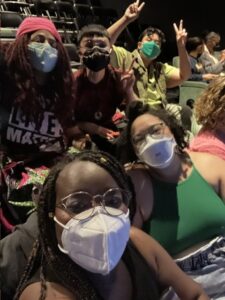
In my experience, this approach can provide experiences that empower people to advocate for more accessibility features for themselves and others. It also ensures that the labor to provide accessibility doesn’t all fall on one person. In August 2026, I was part of CUJ’s Accessible Audiencing team for the co-production of the play “Going To St. Ives” in partnership with the Lower Bottom Playaz, Black Arts Movement and Business District Community Development Corporation (BDCDC), and Disability Justice Culture Club.
Each team member was responsible for a different aspect of accessibility. Someone provided audio descriptions for the set and costumes. Another person created the webpage. Another created the promotional flyer. Someone else created a plain language guide for the play. I was responsible for booking the ASL interpreters, and sourcing PPE (masks and rapid tests) to provide for free at the door. Disability Justice Culture Club supported with community outreach to increase audience diversity.
The Impacts
The results:
- A successful, joyful, and more accessible arts experience for an audience that was majority disabled people of color.
- Increase in audience diversity: the majority of the audience had never been to BAM House (venue) or seen a Lower Bottom Playaz show before.
- BAM House gained further experience and knowledge about accessibility coordination.
- Lower Bottom Playaz and BDCDC gained followers as a result of social media cross-promotion.
- Several attendees reported it was the first time in years they were able to enjoy theater in-person, due to widespread inaccessibility of other spaces.
Reflections
To me, the last impact was particularly invaluable. It solidified my ongoing commitment to producing high-quality public events grounded in accessibility. In my eight years of experience as a community event producer and accessibility coordinator who has worked for both non-profit organizations and independent productions, I’ve learned that accessibility is often not considered a foundational element of the budget. This results in the most common reason why an event isn’t accessible: they couldn’t afford it, because they didn’t plan for it.
Accessibility should always be planned for. Not only because it’s the law, but also because with over one in four Americans having a disability, it’s more likely than not that any event will have disabled people in attendance. Regardless, whens things don’t go as planned, Accessible Audiencing can help by splitting the costs and labor between multiple organizations and volunteers. Inviting everyone to help in the ways they can is the first step in shifting accessibility to be a first priority, even for those with little or no experience in this field.
Instead of a checklist to complete, Accessible Audiencing approaches accessibility as both an ongoing dialogue and collective effort. In this way, disabled and non-disabled people have opportunities to establish authentic relationships. And everyone is encouraged to consider their own responsibility towards advocating for their needs, others’ needs and collective liberation.